
Primum Non Nocere
Artist Statement
This piece is a visual reflection of my experience as both a leader and staff member in my faith community—a journey marked by devotion, disillusionment, and ultimately, a painful confrontation with spiritual and systemic dysfunction.
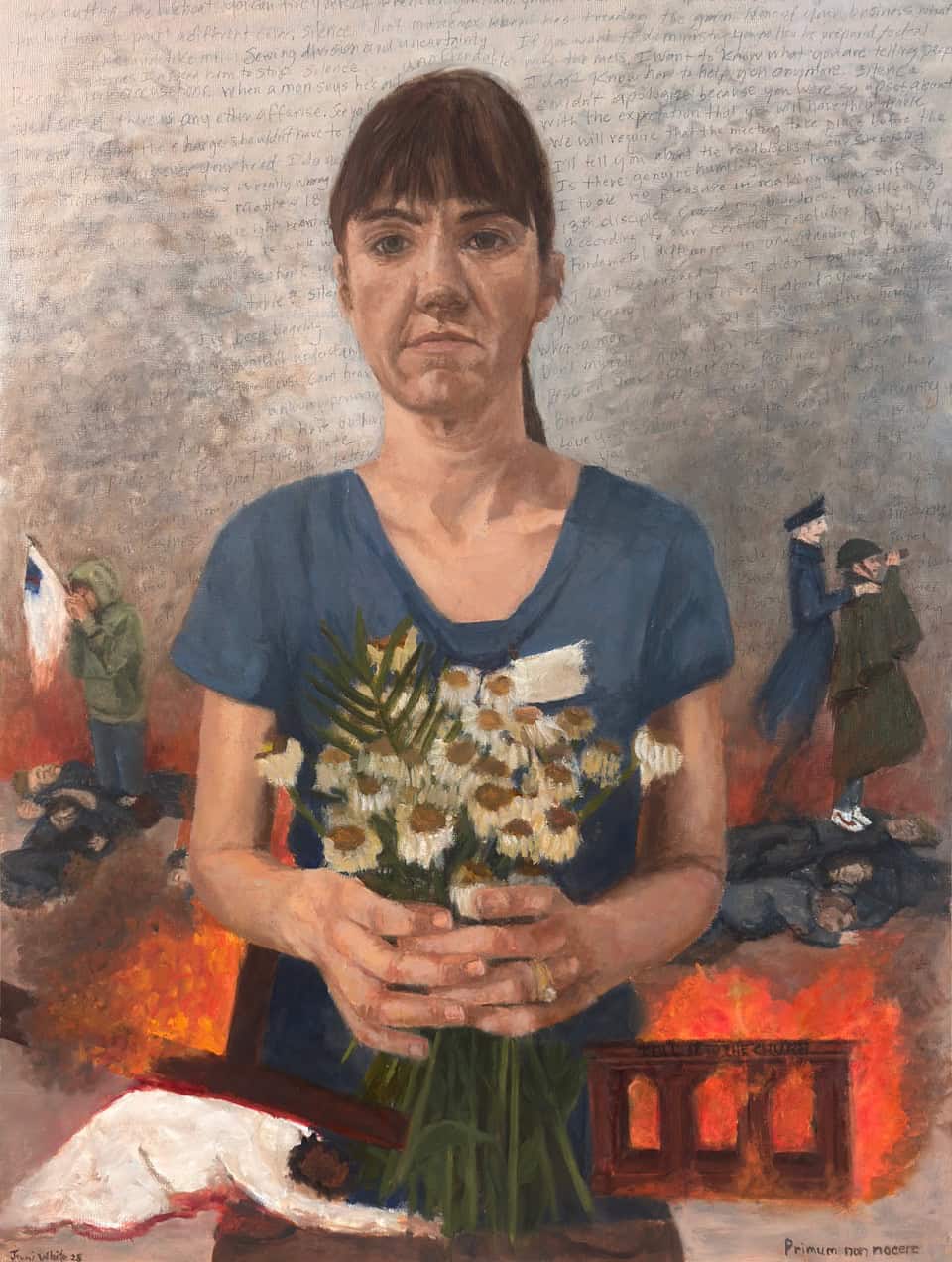
For eight years, I poured myself into this community: thousands of volunteer hours, generous financial support, and ministry through prayer, teaching, leadership, hospitality and shepherding. These offerings, time, talent, and treasure, are symbolized by the dying flowers in the painting. They represent beauty once given in love, now withered under the weight of neglect.
Over time, I witnessed, excused, and forgave unhealthy patterns of behavior, choosing to focus on inner work. I faithfully prayed for our leadership, and I committed to learning about personality dynamics, relational health, and strategies for working with people different from me, all in an effort to build genuine rapport. But eventually, love required me to speak up. Following the guidance of Matthew 18, I addressed these issues with humility and care. I approached appropriate leadership, shared resources, initiated difficult conversations, and urged a path toward growth and healing. My efforts, however, were ignored—dismissed with little acknowledgment. I came to understand that the core values of those in power were not aligned with the values of authenticity, emotional health, or accountability.
As I walked through this painful process, I discovered I was not alone. Many others had been harmed by this same system, some so deeply that they walked away from church and faith altogether. Their stories are represented by the dead and dying figures in the painting and the burning Christian flag, symbolizing disillusionment and spiritual trauma.
On the left stands the figure of a teenager, representing the young people in our midst whose faith has been shaken by toxic dynamics, isolation, and spiritual bullying.
The white flag among the flowers in the painting represents the humility that could have changed the course of this story. Again and again, God extended grace and opportunity to this community through the voices of its people, but those voices were silenced. Their insights, their warnings, their pain—unacknowledged and unwelcome.
I am unapologetically a woman, shown front and center in the piece. And my gender, undeniably, played a role in how I was treated. I watched as powerful, articulate men were heard and honored, while I, and others like me, were dismissed or diminished. It was confusing, disheartening, and revealing.
The palm branch in my hand is my declaration: I bow to no one but Jesus. The words in the background were actually spoken to me and others, phrases meant to deflect, accuse, and redirect. In this community, “offense” is seen not as an opportunity for mutual growth or healing, but as a personal failure of the one who feels it. Above my head, the word “unoffendable” appears—a virtue idolized in this culture. But Jesus is guiding me on a true journey of forgiveness—for every person who hurt me, every time that my name was maligned, every silence that screamed louder than words. He has given me resilience and surrounded me with people who offer real love, kindness, and healing.
The burning cross reflects this truth: you cannot truly follow Jesus without humility. The flaming altar echoes a song we often sang, “Build an Altar.” Like Elijah, I cried out, hoping that if I drenched the altar enough, God would answer with fire. And He did—but not with the fire I prayed for. It wasn’t the fire of healing and revival, but the fire of reckoning and destruction.
I couldn’t “crush disappointment,” as the song instructed. Instead, I found myself like Elijah after his victory, running into the wilderness, broken and unsure I could survive the loss.
The figures on the far right represent the two most powerful men in this community. Here, success is measured by “fruit” and the ability to “keep moving forward.” They are already looking for the next people to welcome, eager to present the illusion of a flourishing garden. But they are blind to the bodies scattered around them—those who were discarded, wounded, or left behind. These people deserve true shepherds.
This piece is my lament, my protest, and my act of worship. My “tell it to the church” testimony. It is a witness to the cost of silence, the courage of truth-telling, and the God who walks with us even when the fire burns everything down.